

How to Maintain Safe and Independent Driving in Later Life

For many people, driving represents cherished independence, allowing them to maintain active lifestyles long into their golden years. However, getting older poses natural declines in vision, reflexes, and cognition, all of which threaten road safety while driving.
Did you know that the number of people between 65 and older increased by 29% between 2012 and 2021 in the US? That means there are a lot of elderly drivers who want to stay on the road.
If you are a senior citizen who isn’t ready to stop driving, it’s not over yet. The good news is that many resources and options are available to help you learn how to maintain safe and independent driving in later life.
What Are the Main Challenges for Drivers Later in Life?
There are a few different conditions that affect control reactions as you get older.
Some common challenges for drivers later in life include:
- Deteriorating vision that makes it hard to quickly read signs or judge speeds/distances accurately.
- Slower reflexes when reacting to sudden pedestrian or fellow drivers movements.
- Stiffening joints reduce neck or shoulder flexibility affecting the ability to check blind spots.
- Cognitive decline making older adults forget routes, mix pedals, or have difficulty processing visual cues such as traffic lights.
- Being on multiple medications to manage long-term conditions may cause side effects like dizziness, risking the ability to concentrate fully.
As an older adult, identifying personal challenges that could occur behind the wheel keeps you from endangering yourself and fellow road users unnecessarily.
Catch changes early so you can create the necessary strategies to maintain safety while driving in later life.
But first, you need the best car insurance for senior citizens.
How Much More Does Car Insurance Cost As You Get Older?
The common misconception is that car insurance only goes up and up as you get older. This table from The Hartford shows the average annual and monthly premium by age group:
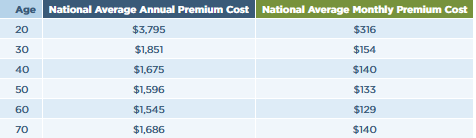
As you can see from the above table, car insurance rates may be lower than you think between the ages of 50-69. This is partly because drivers over 50 are relatively safe drivers.
Nonetheless, car insurance tends to go up after the age of 70, at which point the average monthly cost goes from $129 to $140.
How Can I Find Car Insurance When I Get Older?
There are a few key things to consider when looking for the best car insurance for senior citizens.
As you get older, instead of just fixating purely on vehicle insurance, you should acquire affordable policies from specialist providers who have flexible provisions that match life stage realities.
Always search for the keyword “Over 50 Car Insurance” to filter brokers open to accommodating specific needs beyond generic rates alone.
Review aspects like emergency medical transportation that may need to be arranged after car accidents, substitute driver contingencies for sudden health emergencies and managing recovery in case of vehicle breakdowns occurring miles from home.
Tailored inclusions in car insurance for senior citizens grant you peace of mind and help you use your money wisely. For example, a good insurance provider will be able to tell you that the average cost of auto insurance for a 60-year-old woman is $1,537, as opposed to $1,552 for a 60-year-old man (per The Hartford).
Ensure you look for an insurance broker who can find the perfect policy for you as you get older.
What Steps Can I Take to Drive More Safely As I Get Older?
While mandatory license renewals and vision screenings monitor driving fitness currently, some senior citizens may still lack confidence in being behind the wheel as they continue advancing in years.
It can be helpful to utilize support resources to help you learn how to maintain safe and independent driving in later life.
Here are some steps you can take to drive more safely as you get older:
- Go for regular medical checkups.
- Arrange “Mature Driving Assessments” to identify specific skill deficiencies. You will be given bespoke training responding to unique health profiles in order to preserve ability-adjusting techniques.
- Pay attention to the road and avoid distractions while driving. For instance, don’t eat, use your phone, or talk too much while behind the wheel.
- Ensure you and anyone else in the car always wear a seat belt.
- Seek car modification advice from charities like Eldercare to optimize cabin layouts. It will help reduce twisting, reaching, or visibility struggles that may cause discomfort issues that interfere with your focus while driving. Adaptations ensure access and sustain autonomy.
- When opting for vehicle models, pick one with modern autonomous safety provisions like collision sensors, parking assist systems, and blind spot warnings. These will enhance awareness, reactions, and precision greatly. Technology will bridge capability gaps discreetly as you get older.
- Drive during the day in order to see clearly.
- Avoid driving during rush hour or in places that usually have heavy traffic.
- Plan for any emergencies that may arise on the road. For instance, ensure you keep your phone charged, bring your medication, have the best car insurance for senior citizens, carry a first aid kit, use a GPS tracker, pack basic car repair tools, and install a crash detection app.
- Exercise regularly to improve flexibility, reaction time, and hand-eye coordination.
- Avoid alcohol and drug misuse.
Conclusion
Driving allows precious mobility and convenience that can make a huge difference in later life. Utilize available resources to maximize road safety and maintain independence in your golden years.
Plan adaptations that will smooth the transition to other assisted options if or when self-determined tipping points in your driving abilities as a senior citizen ultimately arise.
Did you enjoy reading this post? Please share it.
Let’s connect: Twitter . Pinterest . Facebook . Instagram . TikTok . VK
Read more articles from Aisles of Life here.
